Let’s be clear: your billing operations are dysfunctional. They might not be derelict, but they’re still too dependent on manual processes which create error, slow responsiveness, and a continuing drain on your cash through inefficiencies. In today’s rapid-paced business environment, that’s not just a flaw it’s a gigantic self-inflicted competitive disadvantage.
The destiny of your financial viability, your cash flow stability, and your customers’ happiness rests on one undeniable fact: Artificial Intelligence (AI) is the future of billing. It’s not a tech gimmick; it’s a radical turning point that switches an aging process to a robust data driven revenue engine.
The Evolution: From Clunky Invoicing to Smart Payments
For many years the billing process has not been enjoyable. Financial team leaders have spent countless hours injecting data, calculating complex contract language, collecting late payments, and ultimately disputing invoices that were inaccurate. This not only wastes time but creates friction with your customer.
Now comes payment AI. In this case, payment AI refers to the use of intelligent systems to learn, predict and conduct financial operations with superhuman reliability. This is the beginning of smart payments, which means that transactions can be so seamless, secure and accurate that they are virtually invisible.
Predictive Billing: Knowing Before You Invoice
We will touch on probably the most transformative shift, predictive billing. Consider a system capable of extracting a customer’s usage data, contractual requirements, historical payment patterns, and other external resources (think seasonal changes) to create an accurate forecast of their final bill before the billing cycle ends.
It’s not magic; it’s machine learning. AI algorithms reprocess and cross-reference massive datasets. This permits you to do things like:
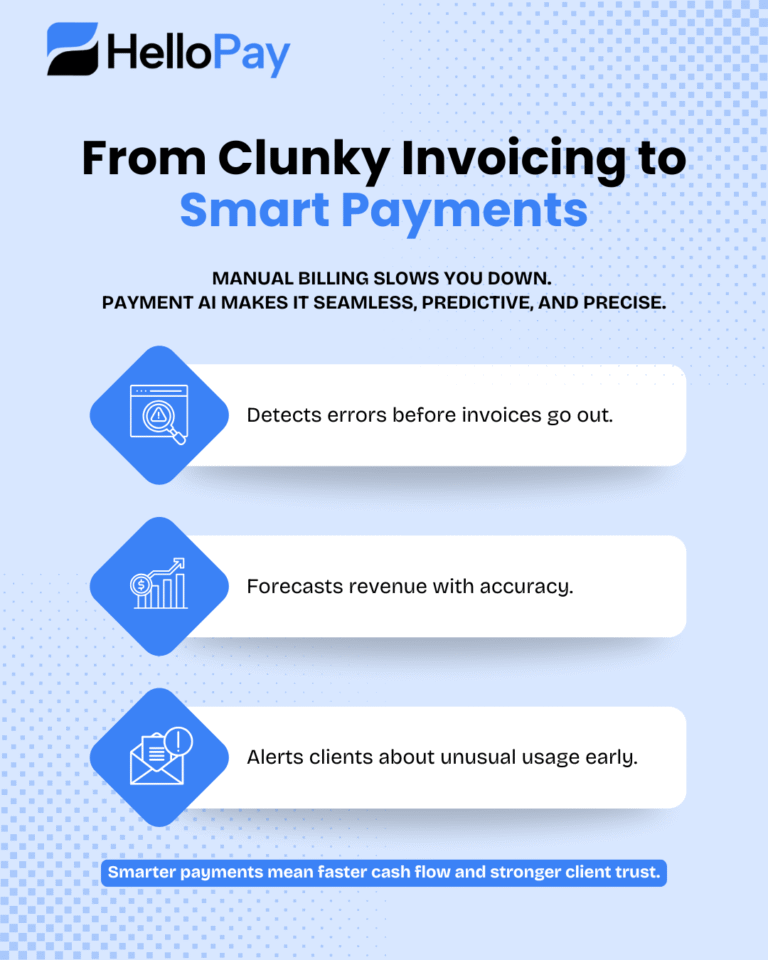
Instantly flag errors: You will have alerts when there are inconsistencies in consumption data, or with the application of proper rates before an invoice is sent out.
Forecast revenue reliably: You will be capable of providing the leadership team with reliable payment projection(s) for cash flow purposes, which is critical for planning purposes.
Communicate proactively : You could alert a customer that their usage increased in an unusual manner, transforming a potential invoice shock into a constructive conversation value-add for everyone.
This level of prescience does not merely enhance invoice accuracy; it turns customer’s relationship evolution(s) from an adversarial “chase” to asset in trust and transparency.
Real-Time Analytics: The Pulse of Your Profitability
In traditional finance, data is frequently examined retrospectively, through a monthly or quarterly report, that reports on what has already happened. The advantage of AI-driven finance is that it is occurring in the moment, and captures the pulse of your business continuously 24/7. Real-time payment analytic is a game-changer. Consumers do not have to wait weeks to be informed of their collection rates by geographic region or product; the data is live. AI models are continually evaluating transaction success, payment gateways, and customer churn based on billing.
What does this assertiveness look like in practice?
Dynamic Dunning: Using AI to determine the right time of day to ask a customer reach out and pay – this has dramatically increased the chances of that customer paying on time! No longer is the email sent at the wrong part of the the week or time of month. Now you have targeted \ intelligent messaging.
Instant Fraud Detection: AI in payments is a giant in safety. It will analyze each transaction for anomalies in milliseconds and identify and flag fraudulent behavior with much greater efficiency than human review and conventional rule-based systems. This protects your revenue and your customers’ trust.
Optimization on the Fly: Your AI system may dynamically route a transaction to the payment gateway with the highest propensity to succeed, even though the primary gateway is experiencing a brief lag. This sort of micro-optimization reduces the likelihood of false declines which are lost revenue.
Conclusion
For today’s organizations, the use of AI-enabled billing and Smart Payments has morphed from a nice-to-have to a business need. If you want to grow, optimize, and retain customers efficiently, now is the time to move to your future billing methods. This solution relieves you from the most critical aspects of an unproductive, manual, error-prone work day, and gives your finance team a chance to become a strategic partner in instead of an error-recovery team.
Moving to a systems-based platform utilizing predictive billing and real-time payment analytics, means you are moving from a reactive mindset to a more proactive and intelligent revenue management style.. You will notice a significant reduction in operating costs, an astonishing increase in timely invoice reconciliation, and a more robust and predictable cash flow; which is the true potential of AI-enabled finance: a smart, seamless, and customer-centric system that enables your billing system to go from a necessary evil, to the very foundation of business growth and an advantage over your competition. The time for hesitation has passed; the technology is here, and your competitors are deploying it. Make your business smart.
Frequently Asked Questions
What do you mean by Smart Payments and AI?
Smart Payments are types of digital payments that utilize valuations and technology like AI, machine learning, and automation enabling a faster, more secure payment with no human mindfulness. The AI actually is the intelligence behind the payment - it assesses the payment for fraud in real time, optimizes the transaction by routing it along the path of best success and customizes the experience for the user. It transforms a pure payment into an intelligent financial event.
How does Predictive Billing actually help my cash flow?
Predictive billing is when AI looks at past data, patterns of use, and the complexity of a given contract to give a strong degree of confidence about a final amount in a recurring or usage-based invoice ahead of issuing it. With this knowledge, your finance team can confidently project revenue, proactively address potential payment challenges, and ultimately be more deliberate in managing liquidity. The net positive to all this activity drives improved predictability and management of your cash flow.
Isn't it too expensive and complex of an undertaking to implement a new AI billing system for a smaller business?
Generally yes, while the new process's initial implementation and configurations will take planning, modern AI in payments solutions are becoming increasingly cloud based and modular, allowing even small-to-medium businesses to use this technology. Cost savings from much fewer manual errors, increased payment collections speed, and much higher invoice accuracy is often enough to generate an almost immediate as well as positive return on investment (ROI) from the technology, and will often be seen as more economical compared to continuing to maintain an outdated, inefficient, manual process full of errors.
How does AI provide better invoice accuracy?
AI improves invoice accuracy by automating the entire data flow. It harnesses machine learning to extract and cross-reference data across a multitude of sources (e.g., usage, contracts, price lists) instantly processing the invoice. This removes any level of human error of inputting data, instantly applies complex rules (always!), flagging any discrepancies for review, such as being able to confirm line items match and confirm proper taxes have been applied prior to sending the final invoice, ensuring the customer receives the correct bill to the first time.
What is the greatest benefit of Real-Time Payment Analytics for finance teams?
The most intuitive benefit comes with shifting the finance function from reactive to proactive. Payment analytics in real time empower your team with an immediate, real-time view of metrics that matter, such as, collection success rate, payment method failures, and payment trends by customer. This immediate data provides finance professionals with the ability to act immediately, whether that means changing a dunning strategy, or researching a sudden drop in transaction success instead of reacting after the issue has become a crisis, and support continuous operational improvement, which is the central purpose of AI driven finance.