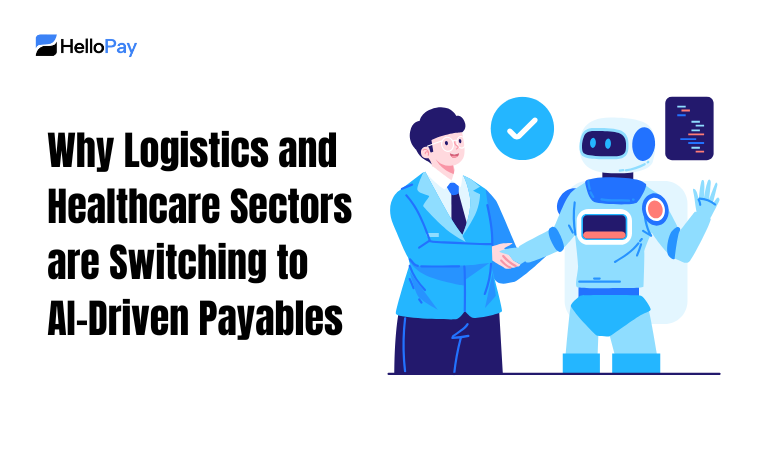
In every sector of business, organizations are transforming outdated receive and pay practices to reflect the vendor-friendly policies they embrace in their customer-facing procurement process. Two sectors in which this change is fastest are logistics and healthcare. Both work on razor thin margins, high transaction volumes, and are under severe regulatory requirements — precarious conditions that beg for improvements with AI-driven payables. This article demonstrates why these verticals are turning to intelligent payables, what value they get from it and offers insights about how to implement an intelligent payment solution and measure its success.
Why the Shift Is Happening
Operational Strain and Volume
Logistics handlers process thousands of invoices daily: the carrier bill, the fuel surcharge, warehousing charges and third party services. Healthcare orgs handle even greater complexity: supplier invoices for medical supplies, lab services, building maintenance and insurance reconciliations. Manual processing results in long cycle times, high error rates, and a failure to take advantage of early payment discounts.
AI-based payables tackle the challenge of volume and complexity with automation of data capture, invoice to purchase order/receipt matching, and intelligent routing of exceptions. The upshot is that processing happens faster and with fewer human bottlenecks.
Cost Pressure and Margin Protection
Both industries suffer from extreme cost pressure. In logistics, fluctuating fuel prices and pricing pressures force companies to find efficiencies. Reimbursement models and labor inflation in healthcare are forcing greater financial management.
AI-driven automated accounts payable eliminates the needs for headcount when it comes to repetitive tasks, reduces late-payment fees, captures early payment discounts and cuts down on duplicate payments. These enhancements mean that margins are preserved.
Compliance, Audits, and Risk Management
Regulation of healthcare is tight with detailed record keeping, audit trails and supplier accreditation. Logistics are cross-border and in every new country you have tax, customs, reporting.
Rules-based payables AI drives better compliance with consistent rule enforcement, automated capturing of required documentation and access to transparent audit trails. The machine learning strategy can be used to surface anomalous transactions as evidence for fraud or policy violations so that the risk detection and response could be enhanced.
Key Benefits for Logistics and Healthcare
Faster Invoice Processing and Cash Flow Control
Cycle times shift from days to hours with automation. Quicker and efficient processing for better insight into cash commitments for strategic cash management. In logistics, this presumably means faster payment to carriers and vendors, resulting in fewer service disruptions. In healthcare, improved control over cash flow enables the purchase of vital supplies and rapid vendor management.
Higher Accuracy and Lower Error Rates
AI is great at reading varied types of data in an invoice, eliminating manual/data entry errors. Smart matching algorithms detect variances and send the real exceptions for inspection by team members only. The less rework the more predictable you can be about your AP throughput.
Improved Fraud Detection and Spend Visibility
Machine learning models train on patterns in normal transaction data and detect abnormal behavior — repeated invoices, atypical vendor activity or changed bank details. Spend data at its deepest level offers views to supplier consolidation, contract compliance and opportunity for negotiated savings.
Scalability Without Proportional Headcount Growth
Voice volumes increase as logistics companies scale up or as health care networks expand through acquisitions. Even as throughput increases over time, AI-enabled payables scale without hiring additional staff so operational costs don’t explode.
Practical Considerations for Implementation
Start with Process Mapping and Data Quality
To achieve successful adoption, organizations must first map out their current invoice flows, ensure they have defined critical exception scenarios and document types. Clean vendor master data and uniform coding policies help AI models work better. Start with the most frequently created and expensive types of invoices for initial automation.
Integrate with Financial Systems
AP-AI works best when paired with ERP and purchasing systems. This type of automation allows for automatic three-way matching, up to the minute status checks and direct posting entries in financial ledgers. It also allows the benefits of a payables process improvement to show up in financials right away.
Define Exception Handling and Human-in-the-Loop Roles
Note not all invoices will auto-clear. Create well-defined exception workflows, and ensure (the HC system) allows staff to process the most complicated cases quickly. Leverage AI to triage and prioritize exceptions, so experts are not spending time on low-value checks.
Address Security and Compliance Upfront
Vendor set up controls, bank detail checking, and segregation of duties. Make sure that the service provides immutable trails and it complies with retention policies in your region. For health care, protect patient-related spend data and contractual confidentiality on top of that.
Measuring Success
Key Performance Indicators (KPIs)
Measure KPIs (e.g., invoice processing time, cost per invoice, percentage of invoices automated), including the number of exceptions and early-payment discounts captured and reduction in duplicate payments. Monitor fraud alerts and resolution hours as a measure of risk reduction.
Financial Impact
Estimate hours saved, late penalties averted and net benefit from discounts taken. In logistics, you can include better relationships with vendors and diminished disruption in the supply chain. Factor in shorter purchasing cycles and tighter budget control on the clinical side with health care.
Continuous Improvement
AI models get better with more data. Monitor exception trends, re-train models for new invoice types, and update business rules as new policies are created. Schedule regular reviews of model decisions and compliance capabilities.
Challenges and How to Overcome Them
Resistance to change is common. Get finance, procurement, operations and compliance stakeholders together early. Provide clear, no-conditions-attached training and explain that automation allows workers to employ holistic thinking rather than just ticking off a checklist. Manage expectations: First day accuracy gets better over weeks as the system ingests data and exceptions get resolved.
Integration complexity is another barrier. Focus on designing robust API or data exchange methods and do phased rollouts. Begin with one geography or business unit, and slowly roll it out.
It is crucial to take care of data privacy, and security. Encrypt, use access controls, and monitor payment or supplier data that is sensit
Conclusion
AI-powered payments bring a compelling value proposition to logistics and healthcare: reducing time, overhead costs, compliance, and fraud detection. Mapping current processes, integrating with financial systems, streamlining exception-based workflows and tracking transparent KPIs enables quick wins to be realized and the scope of automation to grow across operations. The result is not only operational efficiency, but also increased financial resilience — a key advantage in industries where precision, speed and trust are deciding factors of success.
Implementing AI in accounts payable isn’t about removing human judgment, it’s about enhancing it, allowing your team to spend more time on supplier strategy and risk management and less time on low level tasks, which can be done automatically at scale.
Frequently Asked Questions
How do AI-driven payables improve processing speed and cash flow?
AI-driven payables automate data capture, match invoices to purchase orders and receipts, and triage exceptions so invoices process faster, improving cash flow visibility and enabling strategic payment decisions.
What compliance and risk benefits do AI-driven payables bring to healthcare and logistics?
They create consistent rule application, immutable audit trails, and machine learning-based anomaly detection that uncover fraud, duplicate payments, and policy violations while supporting regulatory recordkeeping.